Extended edition
Cam Morin on Filming the Tetons
The song that brought the Tetons together
Cam Morin had an entire trip to the Tetons in front of him and, on the timeline in his editing software, a succession of clips of his friends. He wanted the video to move quickly. A country song he describes as an old classic gave him a pace for the cuts and something of the feeling he wanted to keep from the trip. He thought the combination could do better than anything he'd made before.
At the time, he reckons he was two weeks away from giving up on social media. He had been posting regularly and had waited a long time for something to take off. This time it did. When he answered our questions for LiveStory, he put the video at well over a million views across the platforms where he shared it. He had packed an entire trip into a fast run of clips and kept his friends at the centre of it.
Cam remembers the result as a reason to keep going. The video also happened to bring together things that had interested him for years. He could take the camera somewhere with people he liked, find a sound that belonged with the footage and see whether anybody else felt what he felt when he watched it back. One of the nicest things people have said to him since is that the trips he makes with his friends always look fun. There's a considerable amount of work between having a good time and making somebody else want to go and do the same.
The camera his parents rarely let him touch
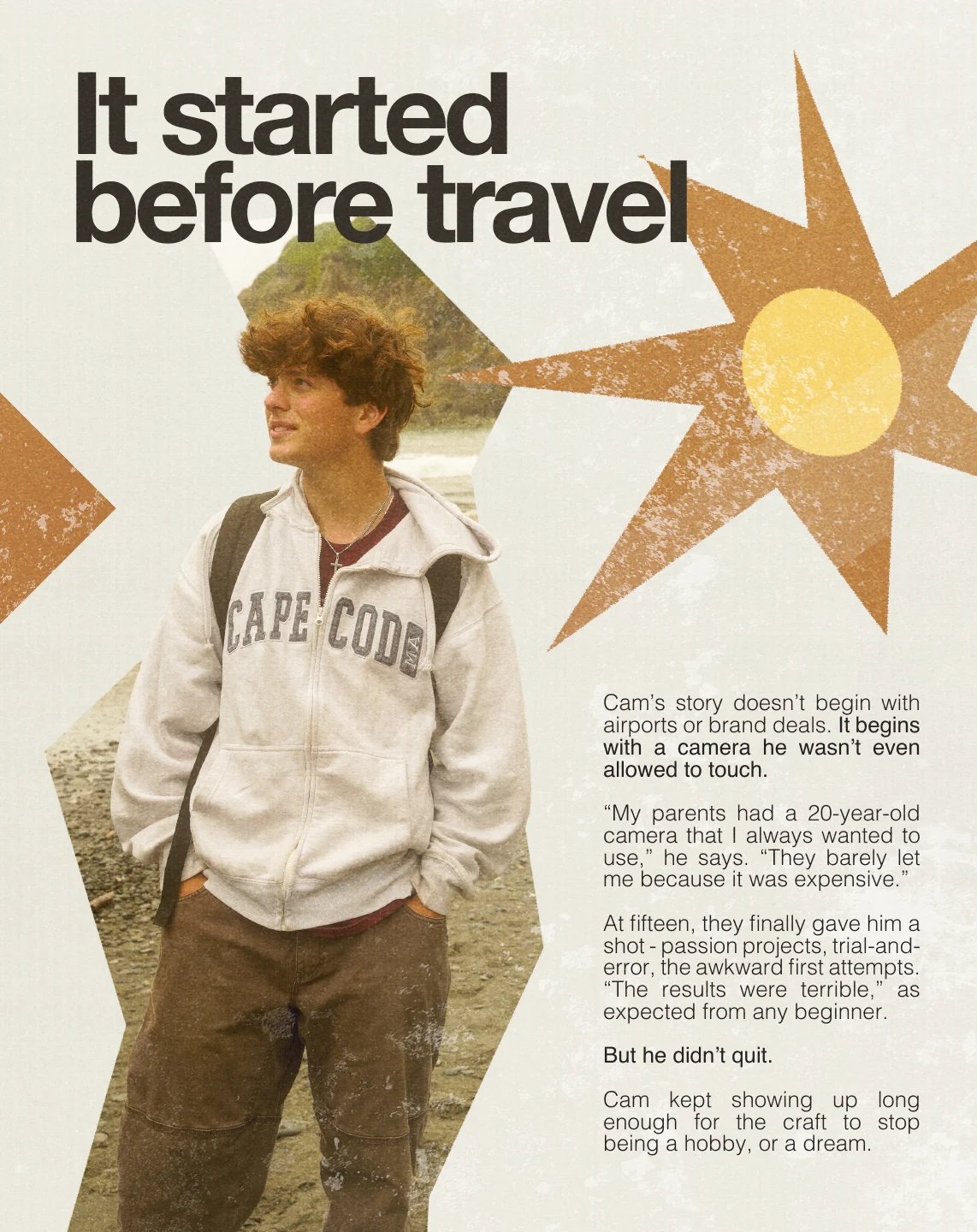
The first camera Cam remembers wanting was already in the house. He describes it as an expensive camera that was about twenty years old. His parents rarely let him handle it. When he was fifteen, they let him use it for projects of his own. He remembers being able to make the things he had been waiting to try. He also remembers thinking the projects were terrible. He kept the interest long enough to take classes in it throughout high school.
Before video became a serious part of his life, he spent a lot of his hours on schoolwork and video games. He talks about having used games to retreat from the world and feeling dissatisfied with how much time that took. “I sold my PC and locked in,” is how he puts the decision to give his attention to something else. Filming gave him something he wanted to spend those freed-up hours doing. The interests he went on to make a living from included photography, commercial videography and the travel videos he would come to be known for.
After high school, Cam began to think about a life for the footage beyond his own computer. He travelled and took his camera along. Other people might want to see the trips. They might also use them as a starting point for making plans of their own. It was a modest idea compared with what he was asking of himself by the time he edited the Tetons trip. All it required at first was a place he wanted to go and a reason to put the camera on.
Starting with sound
The computer is where Cam starts a typical working day. First come the emails, the brand messages and whatever else needs an answer. Once he's through those, he can look for the sound for a video. “I’ll scroll for as long as it takes to find something that clicks,” he wrote. Sometimes a track gives him the idea in the first place. Other times he has already written an idea down and is trying to imagine how it would feel to be in the story himself.
Once he has the audio, he can go through the footage with something in mind. He drops the clips that seem to fit into the editing timeline and says the order and pacing then come quickly. Most short videos he posts take him somewhere between half an hour and an hour to edit. These are his estimates and they tell you something about where he spends his time. Finding the sound can take however long it takes. Once he has it, the decision about where a clip should go often feels obvious.
He pays attention to what happens when a viewer comes to a film with a mood of their own. He has heard from people who came away happy, people who cried and people whose response he describes as happy crying. He talks about choosing the sound with that possibility in mind. A song can set up the pace of a film for him and leave the person watching free to feel something quite different about it.
One night he came across a ski film on YouTube by someone with fewer than a thousand subscribers. The angles caught his attention. He brought footage from the start and middle into a re-edit to see what would happen if the rhythm changed. He cut it to music, built in transitions and sound effects and took out the colour for a grittier look. He was working with shots somebody else had made. His contribution was a different pace, a different sound and a way to give the same footage a new feeling.
Cam says it reached 75,000 views in its first four days. He liked the edit enough to single it out when we asked about recent work. The ski film had first held his attention because of the person behind the camera and the angles they'd found. When he watched his version back, he could also hear what he had brought to it.
A month of rent
Cam dates the decision to work for himself to 1 August, the day a construction company let him go from his videography job for financial reasons. He says he had enough money for one more month's rent. The skills that let him make quick decisions at a computer were suddenly part of a more urgent calculation. He was going to have to find paid work quickly and use what he knew about filming wherever someone needed it.
He approached potential clients and brands. He also looked for students who wanted portraits before they finished school. A graduation portrait and a travel film ask different things of the person behind the camera. For Cam, a portrait was work he could go after that week, while he figured out how the videos he was already making might become a business. He describes creating almost without a break in the period after he lost his job. By the time we asked him about it, he was doing the work full-time.
He had already been putting in long stretches of regular practice before that point. He reckons he was making and posting two or three things a day for somewhere between two and two and a half years. Even on slower days he tried to get something out. The routine asked him to make a judgement about when an edit was good enough to share, then come back with something else the following day. He took the quality of each piece seriously. At that pace, each video also had to be one that he could finish.
Numbers can make that habit harder to keep. He gives the example of a film getting about 8,000 views on a day when he knows another might do 50,000. It can feel as though a quiet result tells you something about the next one. The Tetons video came when he was close to stopping, and he still remembers just how close. That stretch taught him the usefulness of showing up with another piece of work even after a result that made him doubt the time he had spent.
A whole month of Bali
Cam had passed a thousand YouTube subscribers when he answered our questions. He was working on a film from a month in Bali, more than an hour long. He felt it was a chance to give YouTube sustained attention after a year in which he had made relatively few films for it. His estimate for another recent edit was around two hours of editing for a video that ran to more than twenty minutes. The Bali film asked him to work with a much longer stretch of travelling and to see what might hold somebody's attention over that length.
He was also making plans to live out of his car and take a series with him on the road. That meant selling things he owned and making the car somewhere he could live. He intended to make the move in March, which gave him a few months to get the car ready. He was looking for partnerships with companies that made the things he would actually need, including a rooftop tent and kit for cooking and camping. It was still a plan when he answered our questions. Its practical demands were clear. He would need somewhere to sleep, ways to support the work and a reason to turn the camera on in each new place.
The question he asks himself about the short films can work here, too. “Would they want to send it to a friend?” he wrote when we asked what goes through his mind about a viewer. He thinks about how the person will feel while they're watching and whether the trip will give them ideas for something to do together. Give the video an hour and you can leave in a little more of the day. There might be time for the things he likes about being outside as well as the parts that are easy to cut to a song.
Cam likes being recognised as the person whose trips with his friends look fun. He wants those videos to have a life beyond the moment someone sends them on. One way to know they'd done what he hoped would be to hear that two friends had watched one and started talking about where they could go.