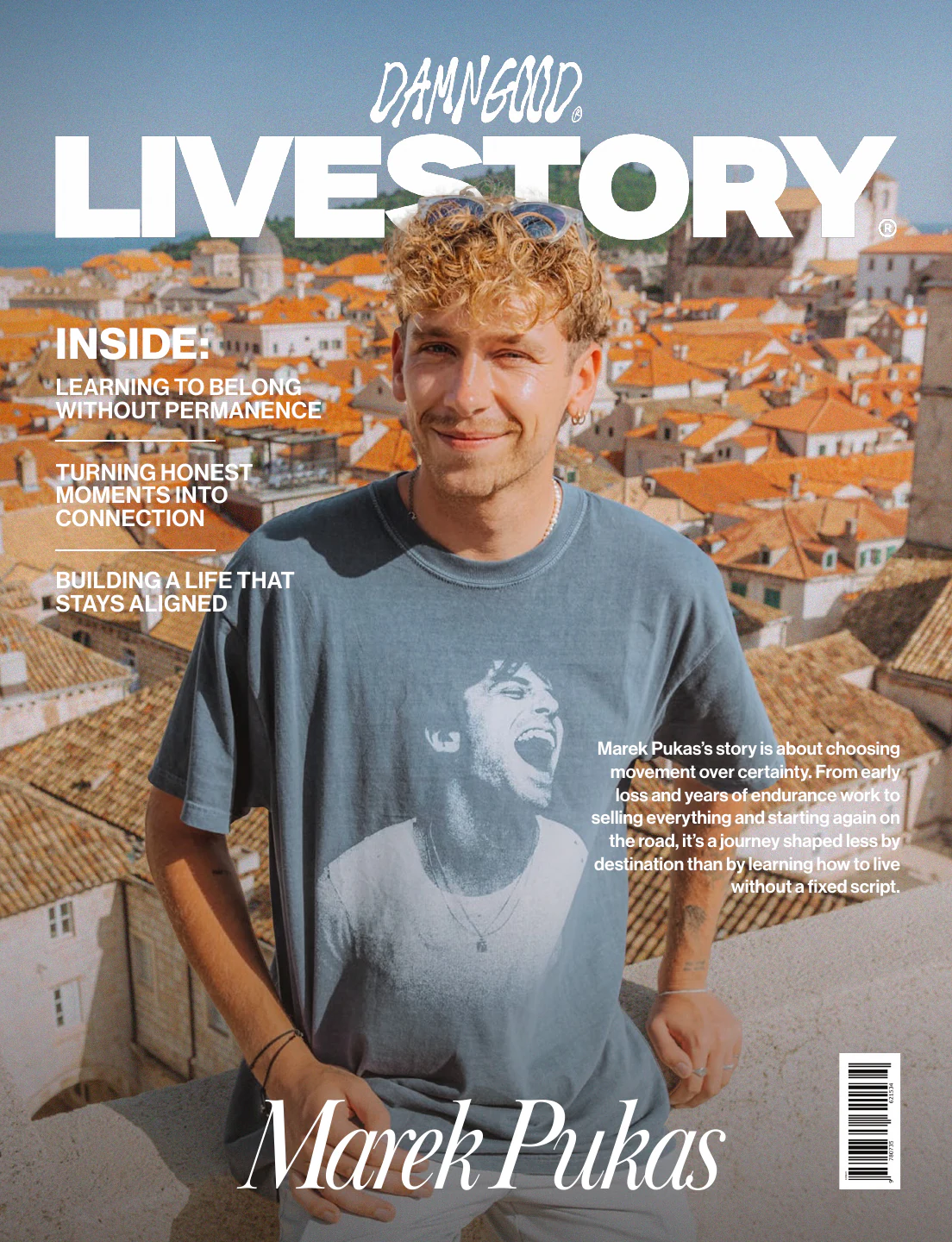
Extended edition
Marek Pukas on Filming Slow Travel in Sri Lanka
The road past the hostel
In Sri Lanka, Marek Pukas got on a motorbike with the owner of the hostel where he was volunteering. They were going to look at buildings. The owner had an idea for a community space where travellers could help local children learn English and people from the area could share skills such as cooking and crafts. Marek had been filming his time at the hostel, so he brought his phone. When people started talking about the places they were looking at, he stayed quiet and listened.
The clips he remembers taking are small. A hand pointing towards a building. The road going by. The light in the afternoon. Later he made a longer video from the fragments. He added a voiceover because the footage alone would only tell you that two people had gone somewhere. He wanted viewers to understand why the hostel owner had gone looking, and what he hoped a place like that could become.
Marek had come to Sri Lanka on a one-way ticket and spent two months volunteering at the hostel. Before he flew in, he had written a line in his notes app for the series he thought he might make. “Show what it’s like to build a temporary home somewhere new.” At the time, he had ideas about the things he might film. He would have to get there to find out whose lives would give those pictures a story.
Four in the morning in Dublin
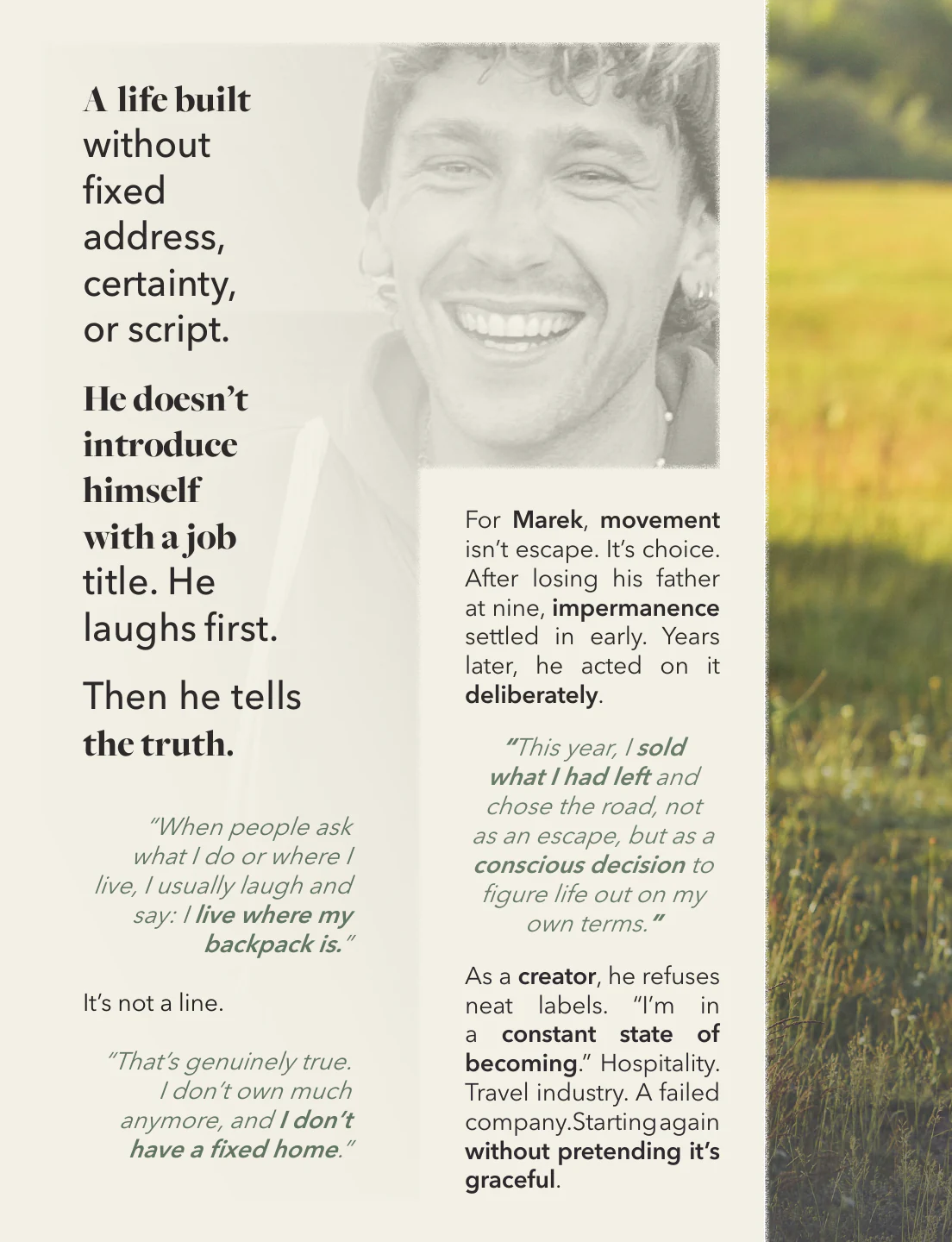
Ask Marek where he lives and he says he usually laughs. “I live where my backpack is.” He grew up curious about the places beyond the one he knew. He liked making things, and his grandmother taught him to knit and let him help in the garden. He remembers learning to be patient with work that takes its own time. When he looked back on that time, he remembered the things he was allowed to try for himself. He was the child who wanted to craft and build and see whether an idea would work. Making something was a way to occupy himself while he wondered why he felt less rooted than the other children around him.
His dad died when Marek was nine. He says he carried a sense of impermanence with him for years afterwards.
Cooking was something he wanted to do for a living. He went to culinary school and started working in hospitality at eighteen. By twenty he was in Dublin, working fifteen-hour shifts in a restaurant for little pay. The hours and pressure wore away his interest in cooking. After a few months he quit and took a job cleaning shopping centres. One morning he was cleaning the toilets at four when he caught sight of himself in the mirror. He remembers thinking he was barely twenty-one and already wondering whether this was how he would spend his life.
There were other jobs after that. He went back into hospitality in front of house, worked as a waiter and a head waiter, and became a supervisor. He worked in Poland and later in Amsterdam. Moving up gave him more responsibility, but it did little for the unhappiness he felt. At times, he says, being a Polish immigrant added to the feeling that he was unwelcome. It took him a while to put words to how burnt out he had become.
Work in the travel industry took him through Thailand, the Philippines and Bali. He left a job with a travel company and tried to start one of his own. When it failed, he sold what he had left and lived on savings. There was already footage from years of travel on his phone and on social media. He wanted to find out whether he could make a living from something he had mostly kept for himself. While his savings held out, he could give the work a proper day and see what there was to learn. He would describe it later as a promise to show up for himself. He already had one piece of evidence that the work could mean something to another person, from a video he had made without thinking about an audience.
A video he almost kept to himself
Marek had spent more than eight years posting when he got the chance to travel. He wrote mostly in Polish and used social media as an archive for stories and footage he wanted to find again. A sunset in Australia ended up in that archive for a different reason. He had been travelling full-time for nearly two years and felt lost. He remembers thinking that going home might be his only option. He sat down and recorded himself trying to make sense of it.
He showed the video to a friend. She told him to post it. In his account, the reel brought in more than 30,000 followers and hundreds of messages. People wrote to say they recognised how he felt. That was the part he kept thinking about. For years he had known what it felt like to make a video for himself. The messages showed him a version of that exchange in which somebody else could look at his life and find words for something they were going through.
On his first collaboration, a gifted trip to Croatia, he found himself on a boat with creators he’d been watching for years. He was excited to be there and more intimidated than he’d expected. There would have been plenty of reason to try to match the work people around him were making. Instead, he spent time watching and learning. He came away with a clearer sense of the films he wanted to make. A simple edit, a little context where it helped, and room to recognise the person who had made it. He began to take that work seriously enough to give it more of his time. Coming up with a way to keep publishing meant deciding which parts of travel he wanted people to see. The videos he liked making included leaving and arriving, and the slow mornings after everybody had got somewhere. The pauses gave him a chance to reflect on what it felt like to keep going when he had doubts of his own.
Two days to get to know the hostel
Before Sri Lanka, the notes app held the first line and a short list. Hostel life, surfing, sunsets, people who had just met. For the first couple of days, Marek watched how the hostel worked and how people got to know one another. He started taking small clips when something drew his eye. A morning at the hostel, then a surf session. People coming and going, or a few seconds of a conversation. After a week or two, he went back through what he’d filmed. The thing he wanted to keep in the edit was the ease he could see between people who had only recently been strangers.
Marek often films on his phone and leaves the decisions about the story until he has had time to think. A place can look lovely in a series of clips. Watching them together, he might find that the moment he wants to build around is a shared meal or the sound of the ocean when everyone has stopped talking. He likes a voiceover to sound like something he might say to himself. Before sharing it, he writes the caption in the same spirit. He pictures one person watching, close enough to imagine being there with him, and tries to give them some sense of what the trip was like when plans were still up in the air. Once a film goes out, he pays attention to what viewers ask about and which details made them pause. Those responses can change what he looks for next time.
The process can take more work than the finished videos suggest. He says he might film a moment fifteen or twenty times on a piece that takes more preparation. There will be words to write, music to choose and subtitles to add. Some posts take hours or days to finish. It can make a quiet stretch of the day remarkably easy to spend on a phone. He talks about having to decide, sometimes at sunset, when to put it away and watch.
Long enough to know people
When we asked how the work was going, Marek had started earning some money from it. He still needed to find a way to pay for a life on the road over the long term. He’d taken an online course on making videos for brands to publish on their own channels, where the brief would be to make something that worked for the client’s audience. The people teaching him offered to train him as a coach. He liked the possibility of helping somebody else get started while building up an income of his own. Going back to being a beginner had helped him work out what he needed to know. It also meant he could learn alongside people interested in the same kind of work. After making so many decisions about travel and jobs on his own, he was interested in what they might make together.
For a while, getting on another plane had been his way of finding out what he wanted to do. He still leaves space for a change of plan. While he was in Sri Lanka, for instance, the chance to go to a two-week surf camp in Australia came up and he took it. When he spoke about the year ahead, though, he wanted more time in each place. He wanted routines he could work around, enough money coming in to make the work sustainable, and the chance to know people well enough to share more than a few days with them.
“I want to slow down without stopping,” he told us. A place could become familiar enough for somebody to ask him to come along while they looked at buildings, as the owner had done at the hostel. And if he had his phone with him, he could decide which moments would help tell that story. For those few seconds he let the camera run, somebody else was pointing out what they could see.