
Extended edition
Michael Kitka on Acting and Making Videos
Fifteen minutes on paper
When Michael Kitka doubts the direction he’s taken, he sets a timer for 15 or 20 minutes and starts writing. He writes without stopping until the time is up. If one thought makes very little sense beside the next, he can leave both of them on the page. He learnt the exercise in acting school, where it was called stream of consciousness. He still reaches for it when the work in front of him has become hard to see through everything else he’s thinking about.
He described it to us while talking about building a business. By then there were videos to make, a posting routine to keep and decisions to take about what he wanted to do next. Some of the habits that got him through a day of that work had come from training for a very different kind of day. A timed piece of writing gave him somewhere to be uncertain for a while. Work on a professional film set had given him practice at carrying on with people looking on.
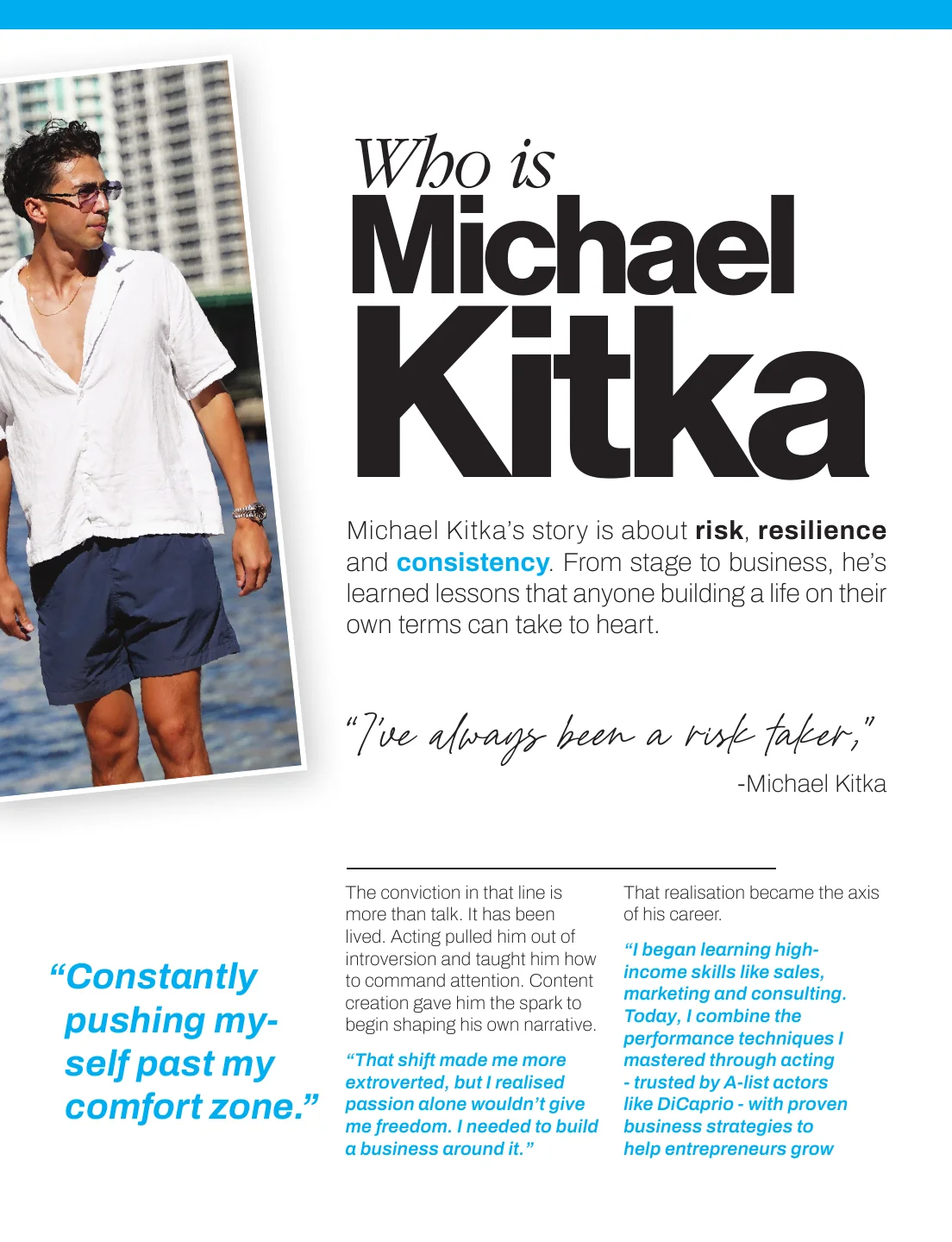
Michael remembers being introverted before he started acting and filmmaking. He wanted to push himself outside the places he felt comfortable. Learning to perform in front of other people changed how he saw himself in a room. Speaking to a camera outdoors, with people who might see him doing it, felt familiar by the time he began posting his own videos. He could talk in front of a camera. He still had to find something he wanted to say with it, and work out how to make a living around that.
Finishing the job
Michael’s first example of somebody who could stay with an idea came from home. His father would get absorbed in building a treehouse, fixing something in the house or working on a campervan design. If the work mattered to him, he seemed to forget about the time. “He never stopped until the job was done right,” Michael wrote. As a boy he saw how much attention a person could give to a thing they’d chosen to do. He wanted to have that kind of focus for the things he cared about, too.
Acting gave him work that could take up that much attention. On a professional set, other people’s time depended on his being able to do his part while they watched. He describes performing in front of hundreds of people and knowing how much money was at stake. Learning to be expressive under that kind of pressure changed the way he thought of himself. Making his own videos gave him somewhere to use the same skills and choose which parts of his own life would be in the frame.
There was a gap between liking that work and being able to do it on his own terms. He wanted choices about where he worked and the time he could spend with people he loved. He began to think about what he would need to learn to build a business with the camera work at the centre. Sales, marketing and consulting were skills he could practise while he was still deciding what that business would be. Finding people who knew how to do them made the idea easier to picture.
A trip that made the work look possible
Michael’s friend and mentor Nathan brought him to Dubai to make videos and introduced him to people who had started their own companies. At first he saw the freedom he’d wanted for himself. These were people who could make choices about their work that had seemed a long way off to him. Spending time around them gave him a chance to ask what had gone into getting there. He came away thinking about how much some of them had put into their businesses at the beginning, when they had fewer of the choices he was seeing now.
He was curious about how they had organised the work over time. A task could take the same amount of effort on two different days and be worth more to the business on one of them, depending on what else it made possible. He was beginning to understand what people meant when they talked about getting more from their effort as the business grew. “They had simply been playing the game longer,” he wrote of the founders he’d met. Experience was an advantage he could imagine acquiring. The trip made him want to give his own business a proper go.
Nathan’s introductions carried on mattering after Michael was back in Vancouver. Some of the people in the wider network lived there, too. The work habits he’d been curious about abroad were things he could now watch people put into practice closer to home. The reach of that introduction was something Michael kept coming back to in his answers. He’d wanted to meet people he could learn from and had come away with people he could stay in touch with.
Taking the camera outside in Vancouver
“Vancouver will always be home to me,” Michael wrote. In summer he likes having lakes and beaches nearby. In winter he can go up to Cypress or Whistler. He also volunteered how expensive the city can be. He has travelled enough to have opinions about where else he could live and still says he’d pick Vancouver. A lot of the places where he likes to spend time are places he can take a camera.
When he was learning sales and marketing, he started putting out videos about the work as he went. Giving himself something regular to share helped him get used to explaining what he knew. His mentors had given him things to try, and if he learned something he could make a video about it. The more time he spent saying these things out loud, the easier it was to talk about them without signing himself up for a formal performance. In Vancouver, he began taking those conversations outdoors.
Michael credits the locations and the relaxed way he spoke in them with helping the videos find an audience. He had seen plenty of people recording advice on personal branding with a desk and a carefully lit backdrop. Being comfortable enough to record outdoors gave him some range in how a video could feel. He could be somewhere that made sense to him and still give the person watching a clear thought to take away. Parts of Vancouver he knew from the rest of his life could now turn up in his work, too.
What it takes to post again tomorrow
There was a point when Michael had spent heavily on training and was broke. He was still fairly new to running a business and making mistakes as he went. It forced him to think harder about where the money went and what he could do with something he’d paid to learn. He valued what his mentors had taught him about sales and marketing. He was also the one who had to go back to work and use it. His account of that time gives the choice to post regularly a particular urgency. The thing he was making each day was also how people found out what he could do.
“I have always been good at keeping promises to myself,” he wrote. He can be hard on himself when he falls short. Making the videos also depends on being practical with the material. He uses Descript to remove silences and filler from a video of him speaking to camera, or to find a short passage in a longer recording. The minutes saved by doing a routine part of the edit faster matter when he wants to come back to it the following day. There are also days on which the thing that gets him back to work is fifteen minutes of writing first.
When we asked what he’d do if he lost his audience, he joked that he’d start by following himself. His serious answer was to choose one person and make a video for them every day. He would imagine speaking to a younger version of himself and explain a skill he’d since learnt. After a month, he’d look at what people had responded to and try some variations on those formats. In his client work, he draws on the experience of learning to communicate for himself. He talks about helping people who want to get more comfortable on camera, on a sales call or in front of a room.
An idea for the big screen
The work he was doing when we spoke was still taking shape. He had stepped back to look at his videos as a whole and was considering what to change next. He wants a business that lets him keep making things and gives him enough flexibility to spend time with his family. There’s a project he would use some of that time for, given the resources and the right people to make it with him.
“It has always been a dream of mine to fully produce my own feature film,” he wrote. He wants to write an original story, play a major role and bring other artists in to make it together. He has friends in the film industry and people he thinks could help if the timing and the idea were right. When he described the film, it was still something he wanted to make. The attraction was getting to put real time into a story he could care about and make with other people.
A feature film would bring Michael back into a room with a crew, where some of the confidence he takes into his daily videos came from. He knows what it’s like to be in front of a camera when other people are waiting for him to get something right. He can also picture working on the story before anybody is there to film it. First he’d want to find the thing he could sit down and give that much time to.