Extended edition
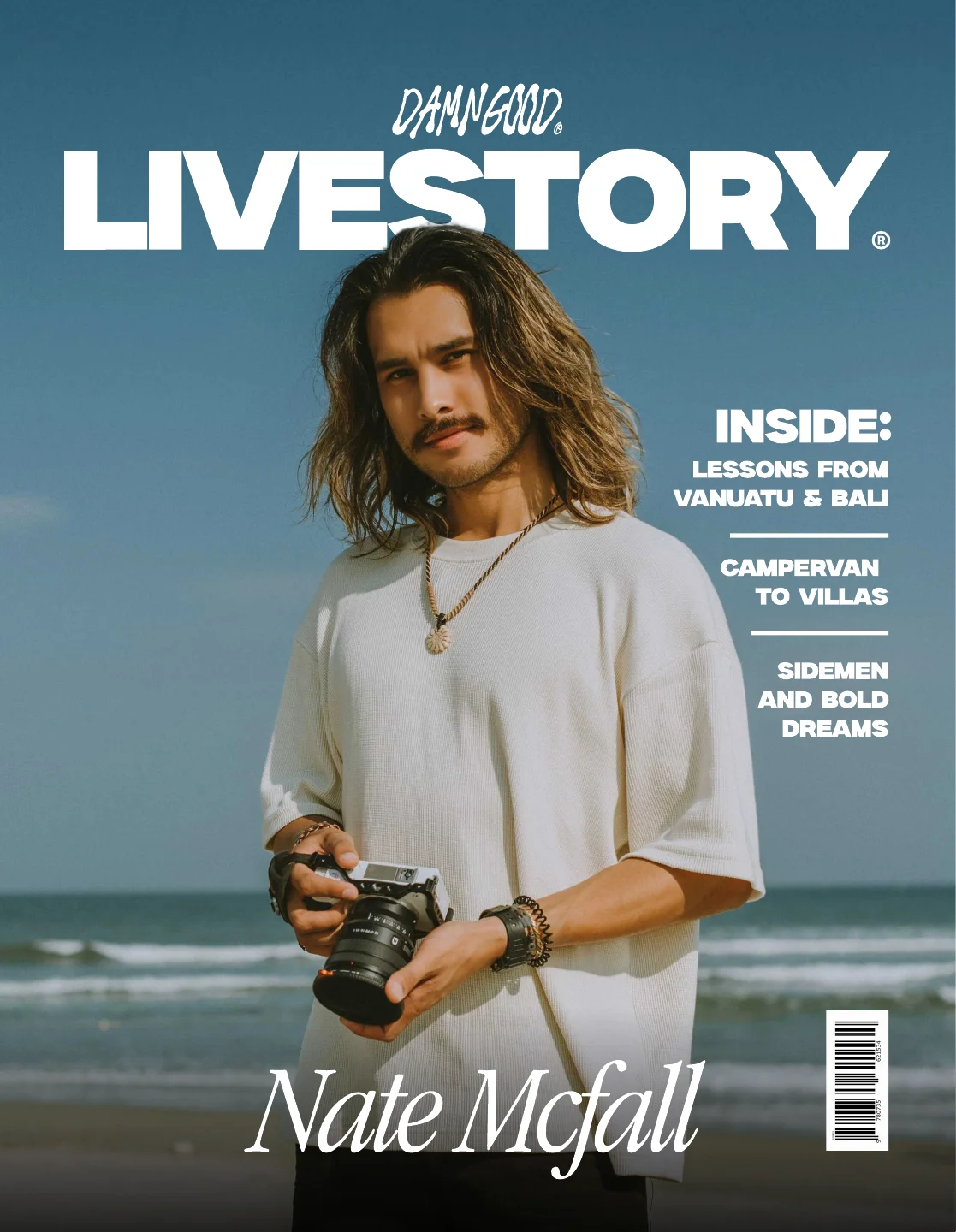
Nate McFall, Travel Filmmaker
The room on the shot list
The hotel had sent Nate McFall details of the room he would be staying in. Each room at the boutique hotel in Uluwatu was different, so he used what they sent him to put together a shot list. Then he checked in and was given another room. The list he’d brought with him was useless.
It was only his second collaboration in Bali. He had gone into it hoping to film in the warm light around sunrise and sunset, but the weather turned at both ends of the day. He made the video anyway. He was unhappy with the result, and by his account it flopped when he posted it. The job still made him cringe. “You know those moments that pop into your head at 2 am and make you want to hide under the covers?” he wrote when we asked about the shoot. He spent two days making a twelve-page pitch deck for the same hotel.
The social media manager had mentioned she was struggling to keep up with video editing. Nate thought he might be able to take some of that work off her hands and turn a one-off shoot into a regular job. He sent a message and tried calling to arrange a meeting. He never heard back.
Looking back, he could see how much he had invested in the idea that this ought to work. On a call before the shoot, the manager had outlined the videos she wanted in some detail. He’d known then how little room he would have to make decisions, and he’d gone ahead thinking good work might change her mind. He had good reason to want the job to lead somewhere. An earlier trip, booked on the strength of one reply, had shown him what could happen when a company took a chance on him.
Five nights, five villas
Nate was working for a travel agent in Australia when an airline bought the company and staff gained access to standby flights. The fares put the South Pacific within reach, provided there was an empty seat. He had a few days of holiday left and about six weeks before his Australian visa expired. He looked at Fiji, Tonga, Samoa and a handful of other destinations before finding a return option to Vanuatu.
He’d posted a few surfing videos and done a couple of small collaborations, one with a beach house and one with a cabin. He still had no proper portfolio. He decided he’d take the flights if he could find someone who wanted him to make a film, so he messaged hotels and holiday rentals around Port Vila, the capital of Vanuatu on the island of Efate. A day passed without a reply. He wondered if he’d reached too far with a few surfing clips to his name.
Then a company that looked after eight villas offered him five nights in exchange for filming five of them. He booked straight away. He remembers both flights being full and somehow getting on each of them. The company picked him up from the airport and gave him a food allowance. Those small arrangements stayed with him. He’d arrived with little work to show and the people who’d invited him made him feel like someone whose time mattered.
They liked what he made. By the time he answered our questions, they’d worked together again and he was still in touch with the owners. ‘They’ll never truly know how much their belief in me changed my own belief in myself,’ he wrote. He could picture making a living this way after Vanuatu. He would have to work out which places he wanted to film and what he wanted his films to show.
A living room that could be a beach
Nate’s dad is a joiner. As a boy, Nate watched him build and fix things from scratch, taking on jobs that looked too ambitious until he went ahead and did them. His dad also spent so much time joking around that Nate assumed that if his dad could do all that, he probably could too. He calls it a ‘weird overconfidence’. It took him a while to see how clever his dad was and how much of the fooling around was for his benefit.
His mum was the one who made sure he did his chores and his maths homework. She went to so many meetings that everyone at school seemed to know her. She was also the one who went wild camping, swam in the freezing North Sea and abseiled off buildings. When Nate moved to Australia, he knew the distance was hard on both parents. They backed him and made sure he understood how much work it would take.
Studying architecture gave him a way to think about why he liked certain spaces. He noticed what a building could do with the place it stood in. A room could catch light at a particular time of day. A window could make a view part of the room. A building could follow the slope of a hill. After university he put his own space together, designing and building a campervan that he lived in for two years.
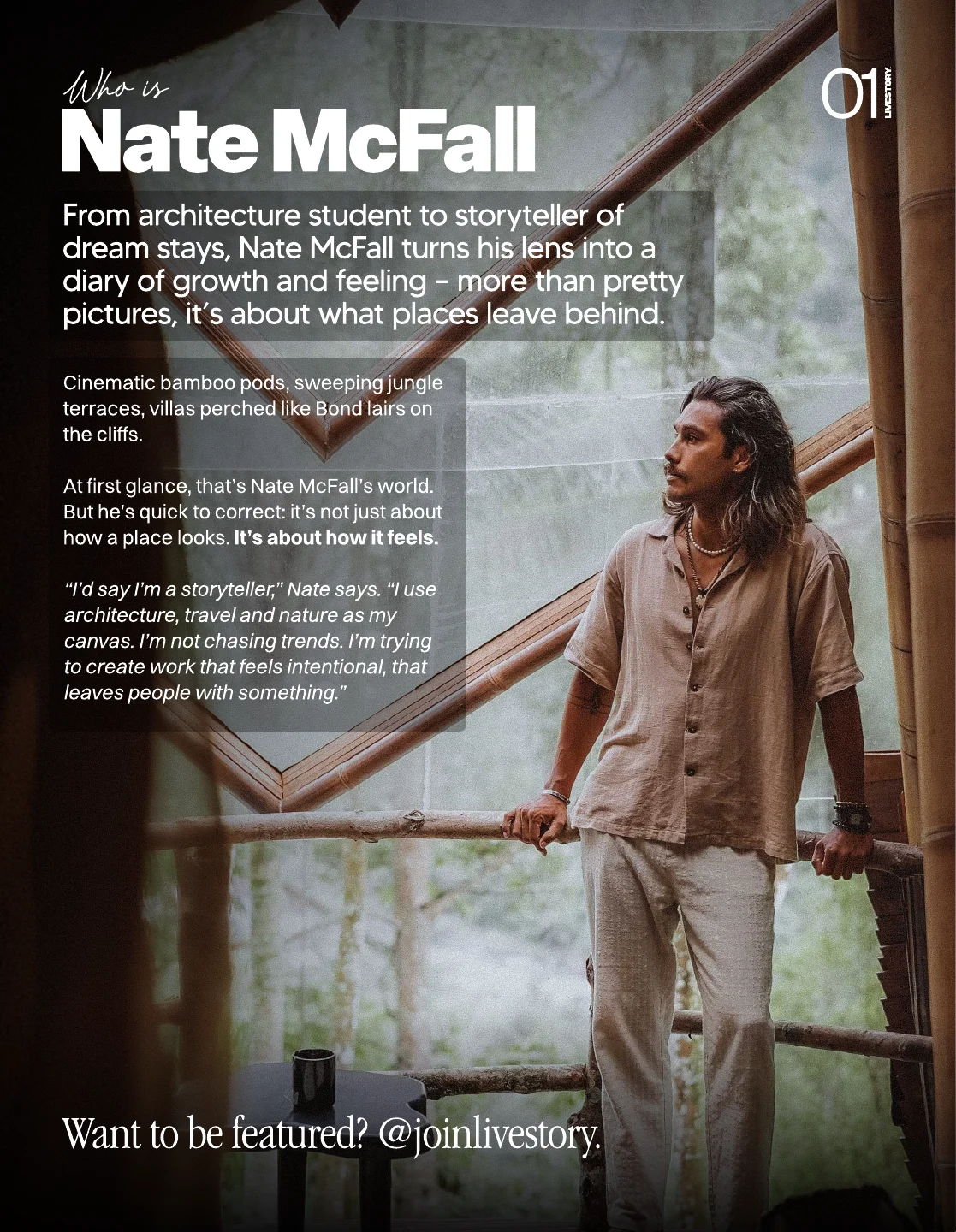
He’d been drawn to biophilic design, the idea that a building can bring the people inside it closer to nature. The van gave him his own way of understanding that. He remembers how much of the day he ended up spending outside. The van gave him a small place to come back to, while the beach, the mountains or the forest could become his living room. When he talks about the bamboo villas he likes to film in Bali, he pays attention to that same movement from inside to outside. The landscape is part of what he’d want you to see from the room.
Finding his pace at Hideout Bali
When Nate talks about Sidemen, he starts with the rice terraces and bamboo villas, then comes round to the hosts. Some gave him enough freedom to slow his films down and tell a story in the way he wanted. That mattered particularly when the travel videos he saw around him were often over in a few seconds. He’d been experimenting with slower reels and had begun to wonder how much use they’d be to the people who might pay him to make them.
Hideout Bali, whose bamboo stays sit in a river valley near Sidemen, was the first big brand Nate remembers choosing him specifically for the way he told stories. He recalls its social media manager telling him she wanted to take their videos in the direction he was already exploring. Before that conversation, he’d been trying to guess how much of his own style he could carry into a job. Here it was part of the reason he’d been asked. He made more films in that vein and says he had worked with Hideout four times by the time we asked about it.
You can see what draws him to those buildings in the way he describes them. Somewhere on a hillside, a designer decides where to put a room so it takes in a view. That decision changes where a guest might linger. It gives Nate something to look for with a camera. A film can give a viewer a little time in that spot, too. His architecture training helps him notice the choices a designer made. Living in the van gave him an idea of how much those choices can affect a day.
The work that happens back at the desk
Nate had been sending as many as fifty pitches in a week when he was trying to find clients. He remembers how exhausting it was to look for the next job that way. Spending more of that time getting better at the films changed who got in touch. He could be choosier about the jobs he took. He started asking whether a project made sense for the people watching his films and whether the client was drawn to his work. Sometimes that meant turning down a job.
At the time of the original LiveStory issue, he’d made a base in Kuta, on the neighbouring island of Lombok. Between shoots he could get some rhythm back into his days. On the working day he’d like to have, he gets up around half six and fits a surf or a gym session around the scripting, storyboarding or editing he wants to do before lunch. He saves emails, admin and photo edits for the afternoon, then writes out what needs doing the next day. He’d like to have the evening free for friends or dinner. When the work piles up, he still finds himself at the desk late.
He can lose time comparing himself with other filmmakers on Instagram, but he also pays close attention to details in the work he likes. Ask him what catches his eye and he’ll talk about subtitles. He likes it when a line of text follows something moving through the picture or sits flush against a wall. It’s a small example of what he looks for in a building, too. The placement makes sense because somebody has paid attention to what’s already there.
The surfing clips are still there
If he could make any series he liked, Nate would spend the night on an old oil rig, in a pod on a Peruvian mountainside or under the northern lights in a glass bubble in Lapland. The idea is to stay long enough to find out what it’s actually like to spend a night somewhere that sounds improbable when you say it out loud. He still has the curiosity that sent him looking through standby routes with a few days of leave to use.
‘My work is a timeline,’ he wrote. He told us he kept the early posts up, ‘cringe and all’. He hoped the films would eventually read like a diary, with enough of the old work there to see how his eye had changed. Someone finding him through a bamboo villa could already scroll back and see where he’d started. A few surfing videos from before anyone in Vanuatu had written back.