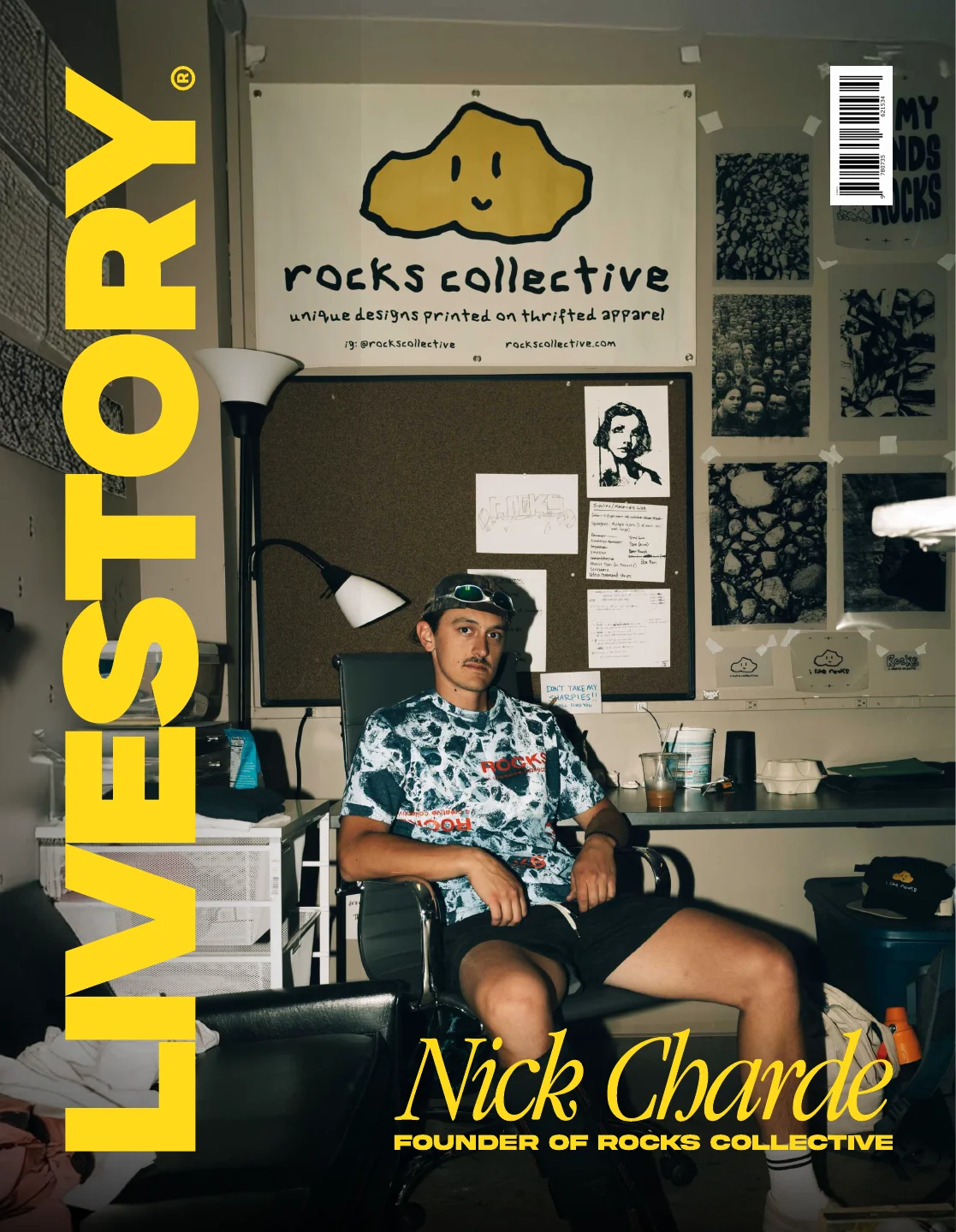
Nick Charde on Founding Rocks Collective
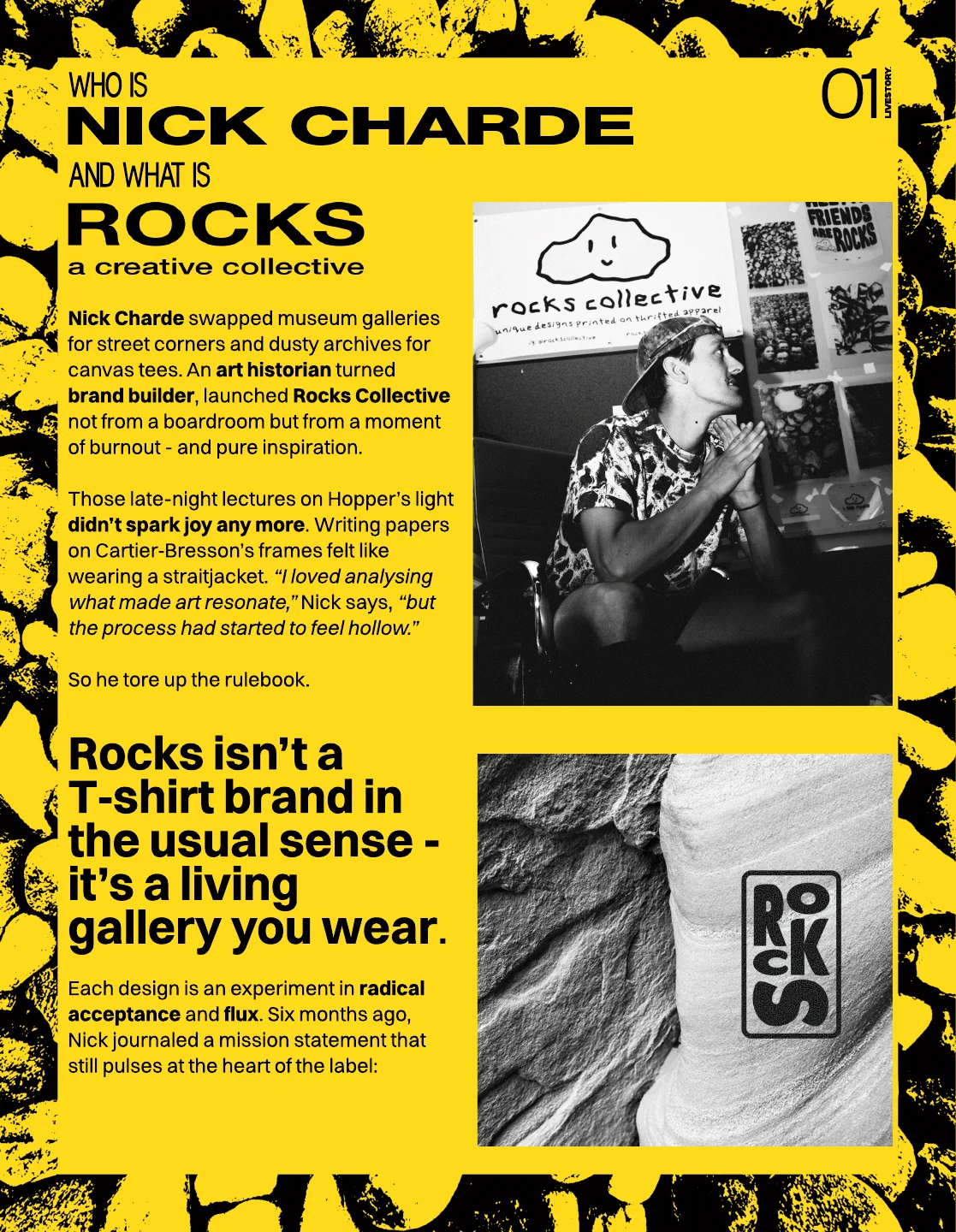
Who is Nick Charde and what is Rocks?
A creative collective.
Nick Charde swapped museum galleries for street corners and dusty archives for canvas tees. An art historian turned brand builder, launched Rocks Collective not from a boardroom but from a moment of burnout - and pure inspiration.
Those late-night lectures on Hopper’s light didn’t spark joy any more. Writing papers on Cartier-Bresson’s frames felt like wearing a straitjacket. “I loved analysing what made art resonate,” Nick says, “but the process had started to feel hollow.”
So he tore up the rulebook.
Rocks isn’t a T-shirt brand in the usual sense - it’s a living gallery you wear.
Each design is an experiment in radical acceptance and flux. Six months ago, Nick journaled a mission statement that still pulses at the heart of the label:
“Rocks is a concept brand based on the idea that the world is always changing. Time moves forward, and so do we... We practice radical acceptance in the work that we do.”
This is more than clothing. It’s Nick’s personal canvas, an invitation for us all to redefine our own.
Now flip the page to see how a single spark of restlessness ignited a collective movement.
Slow burn before the wildfire
“It’s funny - studying art history is actually what made me want to become an artist,” Nick says. “I loved breaking down paintings and understanding what made them resonate. I learned that a painting is just marks on a surface - but a good painting carries something deeper. It speaks for itself.”
That obsession with expression pushed Nick towards creation, not critique. “The ones I admired - Hopper, Cartier-Bresson, Cézanne - weren’t forcing anything. Their work felt like a response to curiosity, urgency, or clarity.”
There wasn’t one clean break - just a gradual unraveling.
“The deeper I got, the more I saw how gatekept and performative the academic art world can be. I didn’t reject it outright; I just wanted to carve out something more open, more human.”
That ‘something’ became Rocks.
“A space built on exploration, not approval. A place where people who feel stuck or unseen can reconnect with what’s possible.”
And in many ways, it reflected his own past. “As a kid, I was constantly sketching my hat collection - drawing them over and over. Looking back, it makes sense that I now use T-Shirts as my creative outlet. Both are casual, expressive, and rooted in personal style.”
More than anything, Nick’s approach is hands-on. “I figure things out by experimenting, making mistakes, and adjusting along the way. Nothing I make is fully planned - it finds its form as I go. That’s the beauty of Rocks - it’s always evolving, and I’m still figuring out what I’ve got to work with.”
He doesn’t romanticise the leap. But he believes in what it created.
“I’m still trying to realise my own potential and see where this can really go.”
Real talk. Real threads.
Growth didn’t come in a straight line. But it came.
“There hasn’t been one defining moment - Rocks has grown through a series of small, powerful ones. Like spotting an ‘I Like Rocks’ sticker on someone’s car, or seeing one of my shirts at the bar. Or getting a message after an event thanking me for creating space for people to connect.”
The feedback loop wasn’t about sales. It was about recognition. Resonance.
“People drop by the studio just to hang out and end up in long conversations about creativity and purpose. Others reach out asking for advice - not just on making art, but on how to stay curious. That kind of connection means everything to me.”
It reminded him what the work was really doing.
“This isn’t just a brand or a business. It’s something people are connecting to on a personal level. It’s not about validation from an influencer or a viral moment. It’s about being real, and giving people space to feel seen.”
Rocks was still personal. But no longer just his.
The ripple effect
Making space, not just stuff.
Nick’s weeks are far from uniform.
“My productivity can be fairly sporadic, but I’ve learned how to work with it.” Between part-time shifts and life’s unpredictability, the studio has become a kind of anchor. “Whether I’m making things or not, I try to be there. Sometimes it’s enough just to be in the space.”
He’s not doing this solo.
The building is shared with other artists. During the community art nights he hosts a couple times every month, the table is stocked with pastels, scissors, glue - whatever might help someone start. “The energy I’m trying to create is one of openness - where people feel safe to try something, or nothing at all.”
It’s not a workshop. It’s not a party. “It’s more like a third space - something between a book club and a jam session.”
Once people start creating, momentum builds. “It’s like being in a jazz group - improvised, collaborative, and totally in the moment.”
Nick’s mantra is scrawled somewhere in most of his spaces: Don’t make art, just make something. “I still have to tell myself that every day.”
When you stop performing, he says, that’s when the real flow begins.
The future’s already sketching itself
Nick doesn’t see Rocks as a destination.
“It’s a living body - constantly evolving, growing, adapting. Not something you observe, something you’re part of.”
He imagines its spirit taking root in places that already hum with possibility - “like a school, a community centre, or even a in a therapeutic environment. Places where people are already gathering, growing, and trying to figure things out.”
And then there’s the dream - half playful, half profound.
“I’d love to open a brick-and-mortar space that’s part gallery, part studio, part hangout. A place where people can come to make things, learn a skill, or just vibe out and feel inspired.”
Also: summer camp. “Screen printing in the woods, art nights by the fire, making zines in bunk beds - it sounds a little wild, but that’s kind of the point.”
He doesn’t claim to have the answers. But he does have something better: direction.
“Twenty years from now, if someone pulls out a Rocks piece or remembers a night at the studio, I just hope they felt free. Free to try something, to mess up, to make something just for the sake of it.”
Because for Nick, that freedom? That’s the whole point.