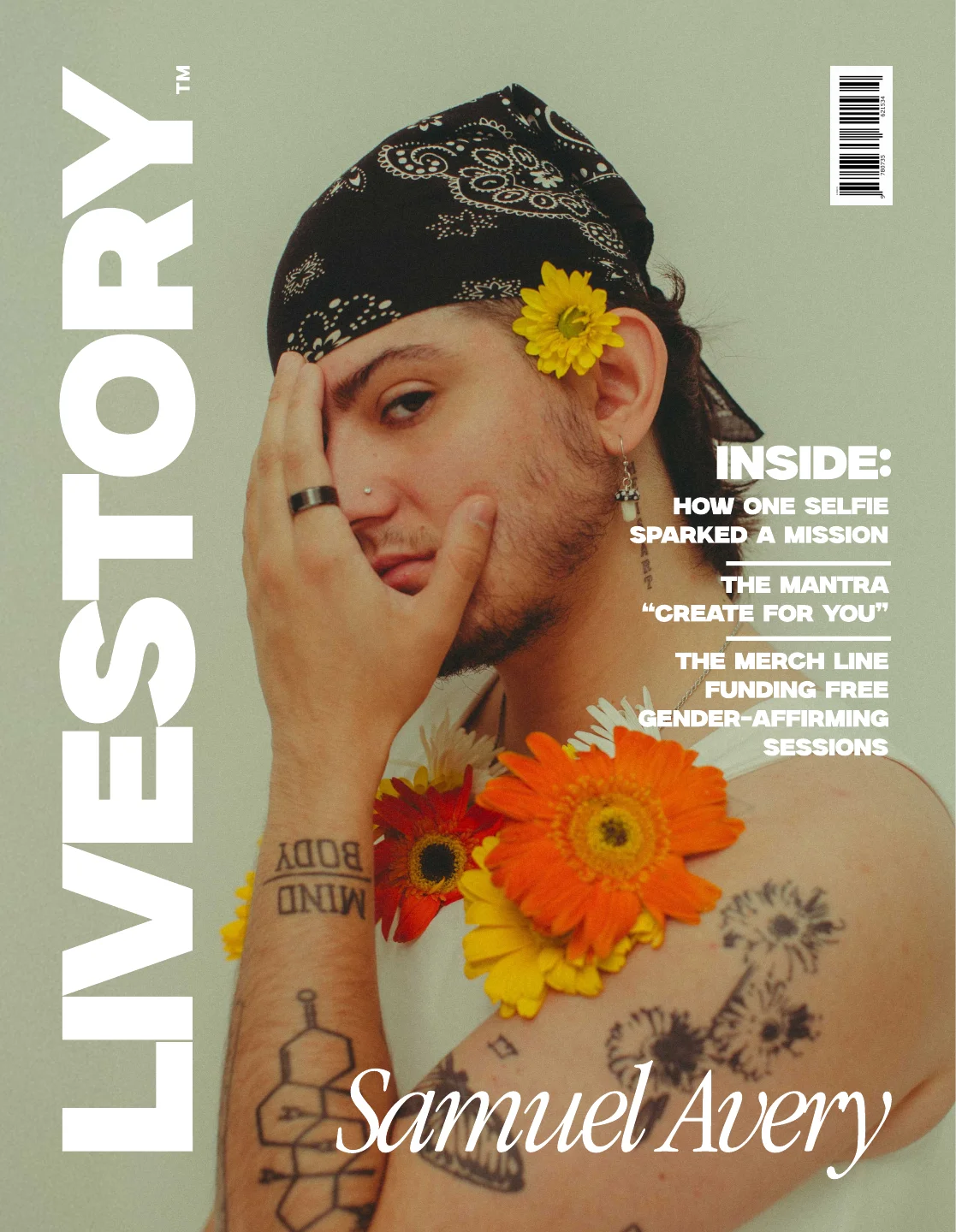
Samuel Avery on Gender-Affirming Photography
Who is Samuel Avery
The self-portraits that found his face, the photographs now changing others’ lives - meet Samuel Avery, the artist turning visibility into action.
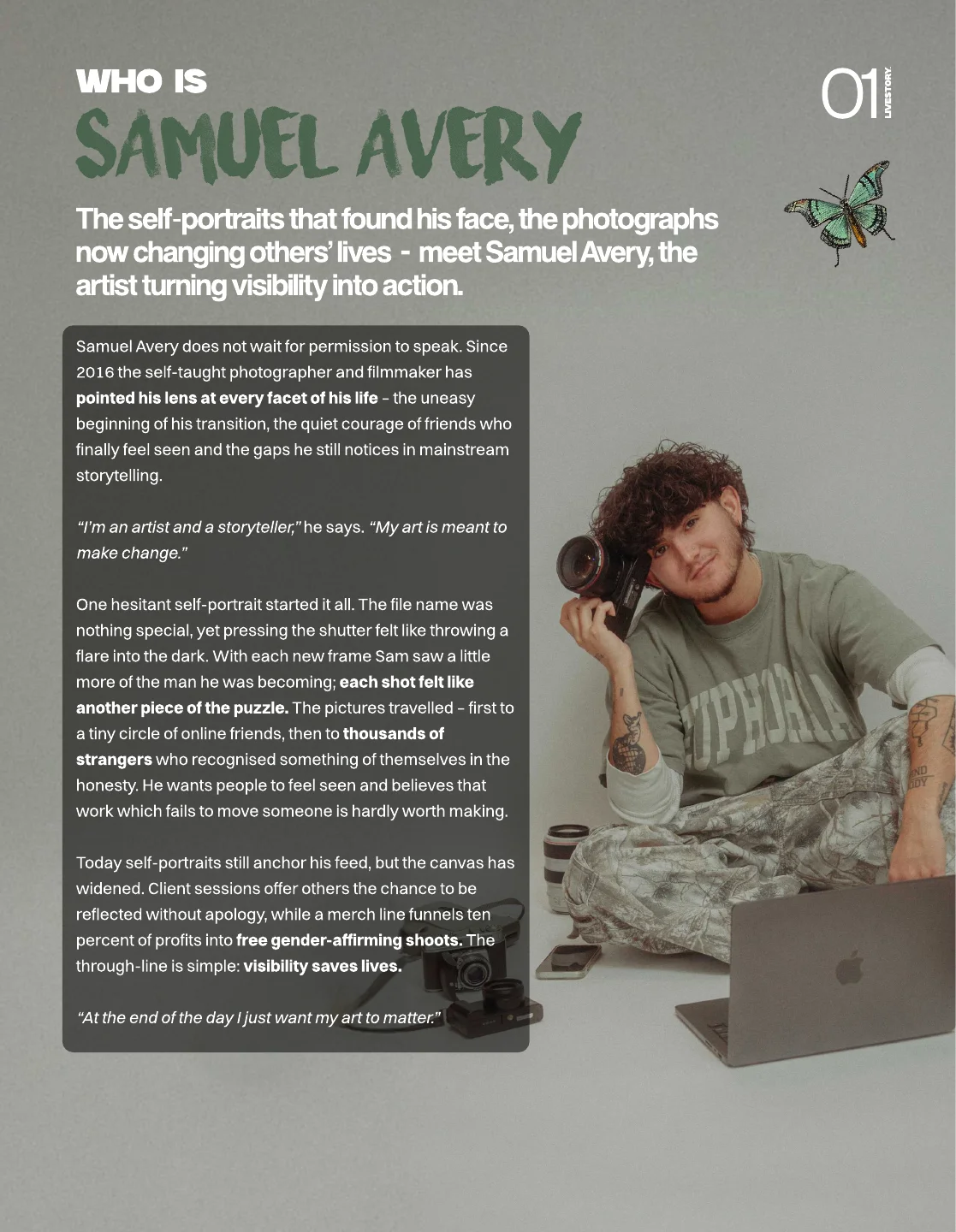
Samuel Avery does not wait for permission to speak. Since 2016 the self-taught photographer and filmmaker has pointed his lens at every facet of his life - the uneasy beginning of his transition, the quiet courage of friends who finally feel seen and the gaps he still notices in mainstream storytelling.
“I’m an artist and a storyteller,” he says. “My art is meant to make change.”
One hesitant self-portrait started it all. The file name was nothing special, yet pressing the shutter felt like throwing a flare into the dark. With each new frame Sam saw a little more of the man he was becoming; each shot felt like another piece of the puzzle. The pictures travelled - first to a tiny circle of online friends, then to thousands of strangers who recognised something of themselves in the honesty. He wants people to feel seen and believes that work which fails to move someone is hardly worth making.
Today self-portraits still anchor his feed, but the canvas has widened. Client sessions offer others the chance to be reflected without apology, while a merch line funnels ten percent of profits into free gender-affirming shoots. The through-line is simple: visibility saves lives.
“At the end of the day I just want my art to matter.”
The First Self-Portrait
Sam remembers sharing his first self-portrait back in 2016. “I see the girl I used to be because for me, the photos don’t reflect the man I am now,” he says. “I remember I loved taking photos of myself, but hated looking at them because I was looking at a picture of someone I didn’t recognise.”
Those early frames were never discarded. He kept shooting, not for likes but for clarity. “I was trying to make sense of everything I was going through, and documenting it helped me process and stay connected to myself.” The camera became both diary and lifeline.
Coming out changed the conversation on both sides of the lens. “Being true to myself wasn’t just the start of my creative journey; it was the moment I finally saw myself clearly.” With that clarity the self-portrait moved from evidence of absence to proof of presence. The evolution is now bound between covers: “I recently published a book of 30 self-portraits. That alone speaks volumes.”
The practice remains his touchstone whenever doubt creeps in. “Self portraits are still my favorite kind of art to create,” he says. And if he needs a reset, the rule is simple: “If there’s one reminder I still give myself, it’s to create for YOU. Not for social media, not for money, not for algorithms or outside validation - just for you.”
Every click still carries that first night’s urgency but now the face staring back is familiar and unafraid, a living record of the distance already travelled.
Milestones
Book in hand, A-list shout-out, first studio keys - the moments that told Samuel the work was taking flight.
“Publishing that book of 30 self-portraits was huge,” Samuel says, tracing the matte cover. “Seeing my own face in print told me the work had weight.” Not long before singer Demi Lovato reshared one of his portraits. “I cried. It proved the work was travelling - reaching people I idolized.”
The next leap came when he turned the lens on others. “Portrait shoots scared me,” he admits. “I’d got comfortable when I was the subject, but once I realised I could turn someone else’s story into art, everything shifted. If photography saved my life, why not let it save someone else’s?”
A physical space followed. “I needed somewhere safe, honest and purposeful,” he says of the studio he and his partner opened in 2023. Furnished with thrift-store couches and framed landscapes, it became a hub for shoots, print sales and community events. “People walked in guarded and left glowing - safe space is part of the craft.” The lease ends this year. “The studio served its chapter, but I’m ready for what’s next.”
Sam’s channels his art beyond the frame. His merch line flips self-portrait motifs into bold tees and hoodies, with 10 percent of every sale funding the Photoshoot Gift Program. “Photography saved my life, so this is how it keeps saving others. I’m turning trans stories into art.”
Demand is global and growing. “We still need more safe spaces for trans and queer people to be photographed,” he says. “Visibility saves lives. A single photo of yourself can change how you walk through the world.”
Rhythm of a Restless Lens
“No two days look the same for me - and honestly, that’s one of the things I love most about what I do,” Sam laughs. “One morning I’m editing wedding pictures until 3am, the next I’m ankle-deep in a lake shooting at sunrise.”
The pace carries a cost. “I’ve definitely experienced burnout before,” he admits. “So I’ve learnt to give myself breaks.” When exhaustion hits, he reaches for the ritual that started everything: self-portraiture. “That’s always been how I reconnect with myself and remember why I started. It helps me to see my growth and remind me of how far I’ve come.”
Self-care also means stepping away from the screen. Often that step becomes a journey: travelling the world, seeing new places and quietly documenting their beauty gives Sam the peace that keeps him balanced. When your passion is your career you never fall out of love with the work - and Sam would rather be on the road with his camera than anywhere else. His days end the way they start - camera nearby, stories waiting - proof that for a restless lens, motion itself is the ritual.
“Once you find your passion. Build on it.”
“The reality of being openly trans on social media is terrifying,” Sam says without flinching. “I’ve received more hate comments than I can count.” Screenshots pile up in a dedicated folder - not for pondering but for recycling. “At this point, I use the hate as fuel. Every rude comment, every ignorant message - it all becomes part of the art.”
One project layers those slurs over new portraits. “Some of my favourite pieces were created using actual hate comments,” he explains. “I know I’m not the only one feeling it - this kind of truth needs to be seen.”
The trolls don’t just target him; they target his community. “Social media can be toxic,” he acknowledges, “but I stay grounded by remembering who I am. I’m proud of what I create. I know the intention behind my work.” That intention is what turns venom into visibility. “At the end of the day, I’m turning hate into something that heals - not just for me, but for the people who see themselves in it.”
For Sam, blocking out the hate is necessary; but transforming it into art is powerful. “Supporting others isn’t just part of my work - it is the work. If my response to hate can help someone else feel seen, then the trolls accidentally donated raw material.”
“My camera gives my community a voice when the world tries to silence us - that’s why I keep shooting.”
On the road again.
Van keys, film rolls and a promise to meet his community where they are.
“My lease is ending this year, and I’m not renewing,” Samuel says plainly. “The studio served its chapter, but I’m ready for what’s next.” What’s next looks like open highways and a second shot at van life. “I invested in a converted van a few years back. It ended up breaking down on the top of a mountain, so I opened the studio instead. Now that the lease is up, I think the next steps for me are to move the business on to the road.”
The motive is access as much as adventure. “Travelling right now as a trans person is risky,” he admits, “but if I can have the opportunity to travel to my clients so I can share their stories through my art, I will do everything in my power to make sure I can do exactly that.”
Equipment-wise, Samuel is keeping it personal. “I’m planning to start teaching myself film photography,” he says, holding the vintage cameras his grandparents once used. “Using my grandpa’s camera feels like a way to honor him.” Road trips will double as classes - YouTube tutorials, trial and error, and plenty of nostalgia baked into each roll of film.
“The world has so much to see,” he adds, glancing at a pinned map dotted with potential routes. “I’m dedicated to experiencing and capturing as much of it as I can - and making shoots way more accessible for my community in the process.”
“More people need to see the world documented through a trans lens.”
Learning, conversation and change
Asked what success looks like a decade from now, Samuel pauses, then answers in three parts: Learning, conversation and change.
“I want people to learn from the images, talk about what they mean and let that conversation turn into action.”
He hopes future viewers will see trans lives recorded with honesty and care. “If a kid finds one of my photos and feels less alone, that’s the legacy.”
“I want my work to be in the history books one day.”
Why it matters.
Art as mirror, megaphone and marching order.
“I want my work to start conversations. I want it to mean something,” Sam says, explaining why every frame is loaded with purpose. One photo can soften fear; a photobook can spark the first honest chat at a kitchen table. “When people see my portraits and then see themselves differently - really see themselves - that’s a win.”
He presses the point with advice he gives emerging creators: “Keep choosing yourself - every single time. Perspective is everything. Look at how far you’ve come instead of what you haven’t done yet.” For Sam, visibility isn’t vanity but survival. If a trans kid scrolls his feed at 3 a.m. and decides to hold on, the work has earned its keep.
“I don’t want to just create impactful work - I want it to help make change. The world sure as hell needs it,” Samuel says, summing up why each project carries more weight than pixels alone.
Asked what unexpectedly shaped his creative voice, he’s clear: “Honestly… my identity. Coming out unlocked everything for me - personally and creatively. It gave me the perspective no one else can borrow.”
Looking ahead, the aim is simple but wide-open: “I want people to learn. I want my work to start conversations. I want it to mean something.” Whether it’s a self-portrait reclaiming my body in a country trying to erase it or documenting a protest demanding our right to exist, the mission stays the same: “I want my art to change how people see my community - more fully, more human.”
He leaves emerging creators with one line he repeats to himself:
“Create the art that you needed when you were younger.”